How to Prevent Drain Clogs Sewer Backups and Plumbing Emergencies in Phoenix
Phoenix heat, hard water, and aging clay sewer lines cause most drain clogs and backups. Here is how to prevent them before they flood your home.
You prevent drain clogs in Phoenix AZ by keeping grease, wipes, and tree roots out of the line, flushing the system with hot water weekly, and scheduling professional drain cleaning before the line fully blocks. Sewer backups happen when those steps are skipped and the pipe finally closes. The rest of this guide covers what actually causes clogs in Phoenix, how often to clean your drains, and the seasonal risks that turn a slow drain into a flooded floor.
We are Emergency Plumber Phoenix AZ, and we have cleared thousands of lines across the Valley. Most of the backups we get called to were preventable two months earlier for the price of a routine cleaning.
Why Phoenix Homes Clog Faster Than Most
Phoenix water is hard, running 10 to 17 grains per gallon depending on which treatment plant serves your neighborhood, and that mineral load leaves scale inside your pipes. Scale narrows the pipe diameter, so the same amount of soap, hair, and food waste that would pass through a soft-water line in another city settles here instead. Add 100°F-plus summer ground temperatures that bake grease into a waxy solid, and you have a plumbing system working against you year-round.
Older neighborhoods have a second problem. Homes built before 1980 in areas like Willo Historic District Emergency Plumber territory often still have original cast iron drain lines or clay sewer laterals. Cast iron rusts from the inside out and snags debris on the rough surface. Clay tile cracks at the joints, and every crack is an open door for roots.
Newer construction is not immune. Builders ran long, nearly flat drain runs in the 1990s and 2000s to accommodate slab layouts, and flat pipe means slow water. Slow water means solids settle. That is why a 2005 home in Laveen can clog as fast as a 1955 home near Central Avenue.
How Can I Prevent Drain Clogs in Phoenix AZ?
Prevent drain clogs in Phoenix AZ by controlling what enters the drain, flushing the line with hot water weekly, and using enzyme treatments instead of caustic chemicals. These four habits do most of the work:
- Never pour grease down any drain. Pour it into a can, let it harden, and throw it away. Even a thin rinse of bacon grease coats 10 to 15 feet of pipe.
- Run hot water for 60 seconds after every kitchen sink use. This keeps soap scum and food particles moving instead of settling at the P-trap.
- Use drain screens in every tub and shower. Hair is the number one cause of bathroom clogs we clear, and a $4 screen catches most of it.
- Flush with a kettle of boiling water once a week per drain. It melts the grease film that hard water has already started to bond to the pipe wall.
Skip the liquid drain cleaner aisle. Sodium hydroxide products generate heat as they react, and in older cast iron or PVC that has already been stressed, that heat can crack a fitting. They also turn grease into a soap-like sludge that hardens further down the line. We have pulled out rock-hard chemical masses the size of a fist from lines that were treated with store-bought cleaner for a year.
Once a month, pour a bacterial enzyme drain treatment down each drain before bed. It eats the organic film that chemicals leave behind. It is slow, it is cheap, and it works.
What Causes Sewer Backups in Phoenix, Arizona?
Sewer backups in Phoenix, Arizona come from four sources: root intrusion at clay pipe joints, grease and scale buildup in the lateral, collapsed cast iron, and city main surcharge during monsoon storms. Knowing which one you have changes the fix.
Root intrusion is the most common. Ficus, palm, and mesquite roots seek moisture and find it at every joint in a clay lateral. A hair-thin root becomes a mat of roots in one season. By the time you notice slow drains, the line is often 60 to 80 percent blocked.
Grease and scale build up in the lateral the same way they do in the kitchen drain, just slower. A lateral that was 4 inches in 1990 may be 2.5 inches of clear opening today.
Cast iron collapse shows up in homes from the 1950s and 1960s. The bottom of the pipe rusts through first, and the channel that remains is rough and narrow. When it finally fails, you get a full backup, not a slow drain.
City main surcharge happens during monsoon season when stormwater overwhelms the municipal system. If your neighbors are backing up at the same time, the problem is not your lateral. Call the city first, then call us if the issue repeats.
If you have already had one backup, the line needs to be inspected with a camera before you assume it is clear. We do that on every drain cleaning Phoenix AZ call because a cleared line with a cracked pipe will back up again within months.
How Often Should I Get Drain Cleaning in Phoenix AZ?
Get drain cleaning in Phoenix AZ every 12 to 18 months for a standard home, and every 6 to 12 months if you have mature trees over the lateral, a home older than 40 years, or a household of four or more people. Those are the three factors that shorten the interval.
Here is how we break it down by situation:
- No trees, home under 30 years old, 1-2 occupants: every 18 to 24 months.
- Mature trees over the line, or 3-4 occupants: every 12 months.
- Cast iron or clay lateral, or 5+ occupants: every 6 to 12 months.
- Restaurant or commercial kitchen: every 3 to 6 months, and grease trap service in between.
Hydro jetting is the right tool for most of these visits. A hydro jetting service Phoenix AZ uses 3,000 to 4,000 PSI of water to scour the full pipe wall, not just punch a hole through the clog like a cable auger does. That is the difference between a drain that stays clear for a year and one that backs up again in six weeks.
Typical 2026 pricing in Phoenix runs $150 to $350 for a standard drain cleaning, $350 to $650 for hydro jetting on a main line, and $450 to $900 if a camera inspection and root cutting are needed. A full sewer line replacement, if it comes to that, runs $4,000 to $12,000 depending on length, depth, and whether we can trenchless it.
Seasonal Plumbing Emergency Prevention in Phoenix, Arizona
Plumbing emergency prevention in Phoenix, Arizona changes with the calendar, and October is the pivot point. We are coming out of the monsoon and heading into the cool season, which is when most homeowners should be doing their annual line inspection.
October through March is the right window for camera inspection, root cutting, and hydro jetting. The ground is cooler, work is easier, and you are not competing with summer emergency calls. This is also when we find the cracked laterals that will fail next July.
April through June is when water heater tanks fail. The anode rod has been eaten away, the tank has been cycling harder through winter, and the first 105°F week pushes it over. Flush your water heater once a year and check the anode rod every three years. If yours is over 10 years old, budget for replacement before summer.
July through September is monsoon season. Two things happen. First, stormwater surcharges the city main and can push sewage back into your home if you do not have a backwater valve. Second, the ground shifts as it dries, and that movement cracks older water and sewer lines. If you have ever had a backup during a storm, get a backwater valve installed before next July.
We also see a spike in Desert Ridge Emergency Plumber calls in late summer when irrigation lines and pool fill lines start leaking after the ground contracts. A slow leak under a slab can run for months before you notice the water bill.
Common Mistakes That Cause Sewer Backup Prevention Failures
The biggest mistake we see is treating a slow drain as a minor annoyance instead of an early warning. A drain that takes 30 seconds longer to empty than it did last year is telling you the line is 40 to 60 percent blocked. Waiting until it stops draining entirely turns a $250 cleaning into a $2,000 emergency with water damage.
Other mistakes that cost Phoenix homeowners real money:
- Flushable wipes. They are not flushable. They do not break down, and they snag on every root and scale deposit in the line. We pull wipes out of laterals every week.
- Chemical drain cleaner as maintenance. It damages older pipes and hides the real problem. It is an emergency tool at best, and even then, a bad one.
- Ignoring the water bill. A $40 jump with no change in habits usually means a running toilet or a slab leak. Both get worse.
- Skipping the camera inspection. A cleared drain is not a fixed drain. If nobody looked inside, you do not know what you paid for.
- Planting trees over the lateral. Ficus, willow, and mesquite roots travel 30 to 50 feet looking for water. If you are planting this fall, keep them away from the sewer line.
One more: pouring coffee grounds, rice, pasta, or eggshells down the disposal. All four swell or bind with grease and form the exact plug we get called to remove.
When to Call a Professional
Call a professional when more than one fixture drains slowly, when you hear gurgling from a toilet or tub, when water backs up into a different fixture than the one you are using, or when you smell sewage anywhere in the house. Those four signs mean the blockage is in the main line, not a branch drain, and no plunger will fix it.
Also call if you have already snaked the drain yourself and it clogged again within a month. That pattern almost always means roots or a broken pipe, and both need a camera and a cutter head, not a hand auger.
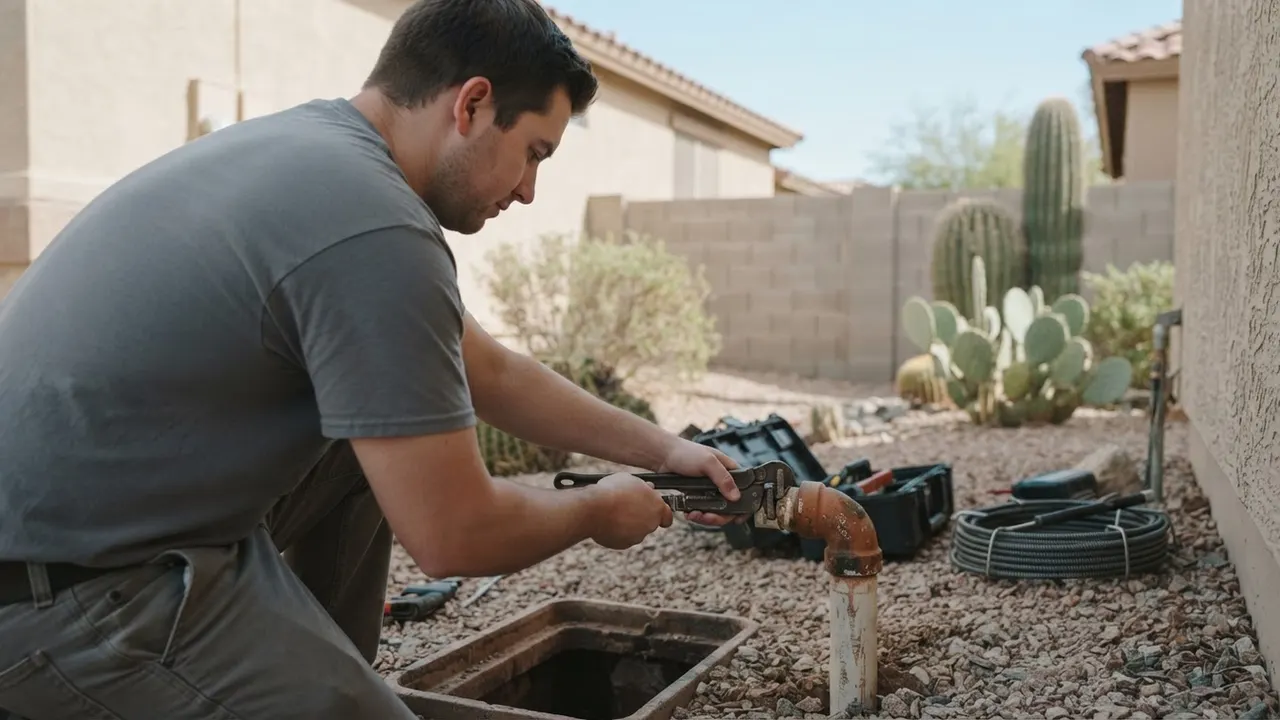
Our team handles high-pressure drain cleaning Phoenix and full camera inspections on the same visit. We find the blockage, clear it, and show you the footage of the line before we leave so you know exactly what condition your pipe is in.
If you are dealing with a burst line, a failed water heater, or a gas smell, do not wait for a scheduled appointment. Those are true emergencies and we treat them that way.
Frequently Asked Questions
How can I prevent drain clogs in Phoenix AZ?
Keep grease, wipes, and hair out of the drain, run hot water for 60 seconds after each kitchen use, use drain screens in every tub, and flush each drain weekly with boiling water. Schedule professional cleaning every 12 to 18 months. Those five habits prevent the vast majority of clogs we see in Phoenix homes.
What causes sewer backups in Phoenix, Arizona?
Root intrusion at clay pipe joints, grease and hard-water scale in the lateral, collapsed cast iron in pre-1970 homes, and city main surcharge during monsoon storms. Roots are the most common cause, and they can block 80 percent of a line before you notice slow drains.
How do I avoid plumbing emergencies in Phoenix AZ?
Inspect your main line with a camera every 18 to 24 months, flush your water heater annually, install a backwater valve if you have ever had a storm backup, and fix slow drains before they stop draining. Catching a $250 problem early avoids a $2,000 emergency later.
How often should I get drain cleaning in Phoenix AZ?
Every 12 to 18 months for a standard home. Shorten it to every 6 to 12 months if you have mature trees over the lateral, a home older than 40 years, cast iron or clay pipe, or five or more people in the household. Commercial kitchens need service every 3 to 6 months.
Does hydro jetting damage my pipes?
No, when it is done correctly. We adjust pressure and nozzle type based on pipe material and condition, and we run a camera first to confirm the line can handle it. Hydro jetting is safer than a cable auger on older pipes because it scours the full wall instead of scraping one channel.
Get Help with Emergency Plumber in Phoenix
If your drain is backing up right now, or you want a camera inspection before next summer, we can help. We clear lines, cut roots, jet mains, and repair the pipes that caused the problem in the first place.
Call Phoenix On Call Plumbing at (623) 260-3130 and we will get a technician headed your way.